
Third Floor, No Elevator: How to Pack a First-In Bag for Walk-Up Calls
Stair carries are among the riskiest jobs in EMS. Six rules for packing a lighter, faster first-in bag, and where a compact 23-liter jump pack fits.


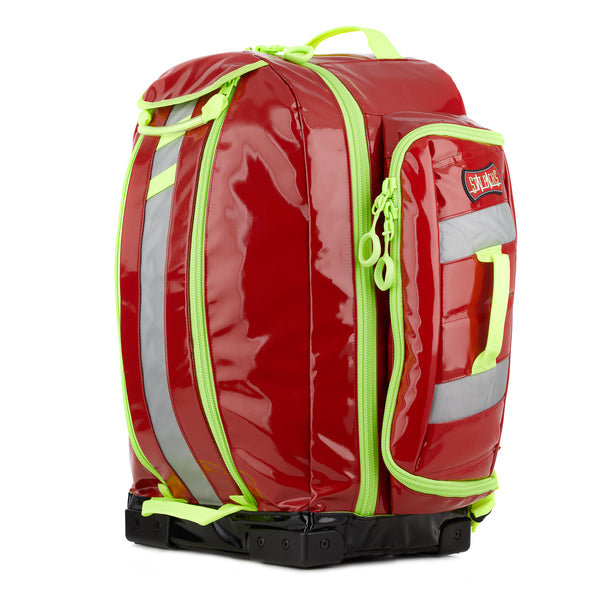
Featured in this article
STATPACKS G3+ Load-N-Go – Compact Medic Backpack (23L)Dispatch says third floor, no elevator. The stretcher won't make the turn on the landing, so it stays in the lobby, and everything you need for the first minutes of the call goes up the stairs with you. That one bag sets the pace of the whole call: how fast you reach the patient, how quickly your partner can find what you ask for, and how much your back has left for the trip down.
Key takeaways
- Lifting and carrying patients and equipment is the leading cause of EMS worker injuries, and stair carries rank among the riskiest tasks.
- A first-in bag should carry the first minutes of the call, not everything you might ever need.
- Pack in order of use, keep every item visible, and weigh the bag loaded.
- Pick a pack sized for your protocol and for the carry you actually make.
Why the stairwell is where crews get hurt
NIOSH-funded research found that musculoskeletal injuries make up about half of all injuries to EMS workers, and that carrying patients down stairs is one of the highest-risk tasks on the job (NIOSH). A national study of injured EMS workers by NIOSH and NHTSA found the same pattern: lifting, carrying or transferring a patient or equipment was the leading cause of injury (Prehospital Emergency Care, 2017).
You can't change the building. You can control what you carry into it. Every pound in the first-in bag climbs the stairs with you, then comes back down while your hands are busy with the patient, the stair chair or the rail.
First-in bag vs. everything else
Walk-up calls work best when the gear is split by job. The first-in bag goes up on every call. Bulk and extended-care supplies stay with the stretcher or the rig until someone needs them.
| First-in bag | Stays with the stretcher or rig | |
|---|---|---|
| Job | Assessment and the first minutes of care | Extended care, transport and bulk supplies |
| Goes up | Every call | Only when it's needed |
| Packed by | Order of use, to your protocol | Volume and ease of restocking |
| Built for | Speed, visibility and a light carry | Capacity |
What goes inside is your agency's call. Protocols and your medical director set the list. The rules below are about how that list gets packed and carried.
6 rules for packing a walk-up bag
1. Pack in the order you reach. The layer you open first should hold what you use first. Items you use later, or rarely, go deeper. When you open the bag on a landing, the first thing you see should be the first thing you need.
2. Make every item visible. Clear sleeves and mesh pockets let your partner grab an item from across a cramped room without asking where it is. They also make gaps obvious at restock, before the next call finds them for you.

3. Build to your protocol, not the catalog. An ALS bag and a BLS bag shouldn't look the same. Set dividers and pouches around your scope of practice, and leave out gear you aren't credentialed to use.
4. Weigh it loaded. The weight on a spec sheet is the empty bag. Supplies are usually most of what you carry. Put the packed bag on a scale once, and again after any change to the loadout.
5. Plan for two carries. Backpack straps for the climb keep a hand free for the rail. Handles cover the doorway, the hallway and the last few feet to the patient.
6. Restock against a list after every call. Same items, same spot, every time. The bag should work the same for whoever grabs it next shift.
Field tip
Have a partner who didn't pack the bag find five items you call out. If any one takes more than a few seconds, the layout needs work, not the partner.
Common mistake
Packing for the worst call you can imagine. A bag stuffed for every possibility is heavy on every call and slow on the ones you actually run. Leave low-use bulk with the stretcher.
Where a compact jump pack fits: the STATPACKS G3+ Load-N-Go

The Load-N-Go is a 23-liter G3+ jump pack built for close-quarter, quick-access calls like the walk-up. It ships empty with a removable organizational divider, so you build it to the ACLS, ALS, BLS or PALS loadout your agency carries.
It lines up with the rules above. Three organization layers of transparent sleeves, mesh pockets and elastic holsters cover rules 1 and 2. Backpack carry and side handles cover rule 5. The Stand-Strong base keeps it upright when you set it down on a landing, so it doesn't tip and spill while you work. A verified buyer on a rural rescue squad called it "roomy without being cumbersome."
| Load-N-Go at a glance | |
|---|---|
| Size | 21" H x 16" W x 8" D, 23 liters |
| Weight | 5.9 lbs |
| Compartments | Main 19" x 13" x 6"; side pockets 16" x 7" x 3"; aux pocket 18" x 11" x 4" |
| Exterior | Double tarpaulin, high-gloss fabric that resists abrasion and water |
| Colors | Red (G35004RE), Blue (G35004BU) |
| Contents | Ships empty; modules and supplies not included |
Staged longer on scene, or carrying a bigger loadout? The G3+ Golden Hour holds 34 liters in a 25" H x 17" W x 8" D body. For setup and deployment, see the Load-N-Go field manual. Buying for an agency or department? Luminary Global is an SDVOSB and WOSB. We accept purchase orders and GPC, and offer volume quotes.
Frequently asked questions
What should go in a first-in EMS bag?
Whatever your protocols call for in the first minutes of care, before the stretcher arrives. Your medical director sets the list. The bag's job is to keep it organized, visible and light.
How heavy should a first-in bag be?
There's no single standard. Keep it as light as your protocol allows, and weigh it loaded, since supplies usually outweigh the bag.
Does the Load-N-Go come stocked?
No. It ships empty with a removable organizational divider, ready for your agency's loadout.
Disclaimer: The information provided in this blog is for general informational purposes only and does not constitute professional advice.
Written by
Ret. Army First Sergeant · Bronze Star Recipient · Founder & CEO, Luminary Global
Leave a comment