
Lights Out at Dinner: How to Light Your Home in the First 5 Minutes
A staged lighting plan for winter outages: who grabs what, where it lives, and why battery light beats candles.


Featured in this article
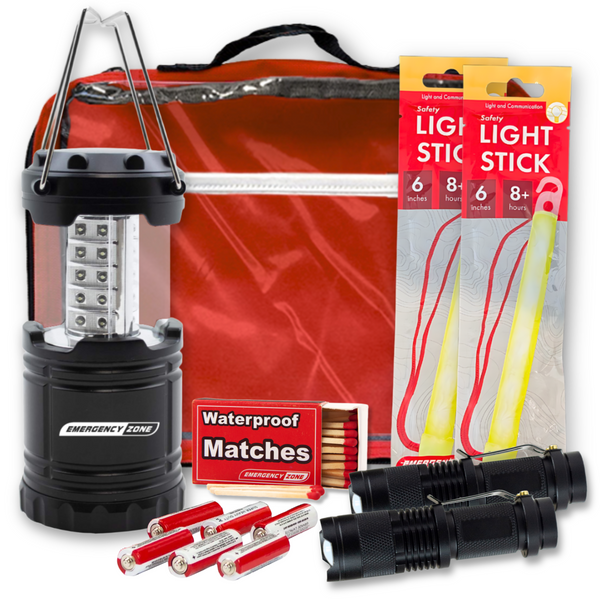
Emergency Zone Basic Power Outage Emergency Kit – Essential Lighting SetIt's 5:40 on a snowy weeknight, dinner is half done, and the house goes black. The furnace fan stops, the kids call out from the next room, and your phone is at 20 percent. What happens in the next five minutes depends almost entirely on what you set up before tonight. A lighting plan isn't gear for its own sake; it's how you keep a dark house calm, safe and easy to move through until the power comes back.
Key takeaways
- Stage your outage lights in one known spot, close to where your family spends the evening.
- Hand out pocket lights first, then light the room, then mark the hallways and the bathroom.
- Use battery-powered lights instead of candles. Keep flame as a last-resort backup.
- Save your phone's battery for calls and alerts. Don't make it your flashlight.
Why a lighting plan matters this winter
Outages are not rare events you can wing. U.S. electricity customers averaged 11 hours of interruptions in 2024, according to the U.S. Energy Information Administration, and most of those hours came from major events like big storms. That's more than a long evening in the dark for the average household.
The first instinct in a dark house is often a candle. The CDC's guidance is clear: use flashlights or other battery-powered lights instead of candles when you can, and never leave a burning candle unattended. A plan built around battery light removes most of that risk before it starts.
Know what each light is for
Different lights do different jobs. Most outage mistakes come from asking one light to do all of them.
| Light | Its job | Where it belongs |
|---|---|---|
| Pocket flashlight | Moving: stairs, the garage, the breaker panel | In an adult's hand or pocket |
| Lantern | Lighting a whole room so people can sit, eat and talk | Center of the table, or up high |
| Light stick | Marking a path or a doorway, hands-free | Hallway, bathroom door, top of the stairs |
| Matches and candles | Backup only, when battery light runs out | Sealed in the kit, used with care |
How to light your home in the first five minutes
- Reach the kit without searching. Keep your outage lights in one spot, near where your family spends evenings, and make sure every adult knows where it is. If you have to hunt for your flashlight with your phone, the plan has already slipped.
- Put a light in every adult's hand first. Before anyone walks anywhere, each adult takes a pocket light. Stairs, pets and toys on the floor are easy to miss in the dark, so nobody moves without light.
- Light the room, not just the path. Set a lantern in the middle of the table or somewhere high, so it lights faces and floor instead of glaring in eyes. A lit room settles kids faster than any reassurance.

- Mark the routes people will use tonight. Place a light stick in the hallway or by the bathroom door so children can find their way without a flashlight. It's a small step that saves a lot of calls of "I can't see."
- Check the panel, then look outside. Take a pocket light to the breaker panel. If your breakers are fine and the neighbors are dark too, it's an outage. Report it to your utility and settle in.
- Keep flame as the last resort. Matches belong in the kit as a backup, not the first move. If you do light candles, follow the CDC's guidance: safe holders, away from anything that can burn, and never unattended.
- Reset the kit when the lights come back. Put every light back in the same spot, replace anything you used up, and check batteries before the next storm. A kit that's half empty in January isn't a plan.
Field tip
Do a two-minute drill after dinner some night this month: kill the lights, time how long it takes to get a light in every adult's hand and the room lit, then fix whatever slowed you down. Pack in the order you reach.
Common mistake
Using your phone as the flashlight. It's the device you need for outage updates, weather alerts and calls, and a long night of flashlight use can drain it before the power returns.
While you wait it out
Light is the first problem, not the only one. Keep the refrigerator and freezer closed: the CDC notes a refrigerator keeps food safe for up to 4 hours without power if you don't open the door. And never run a generator, grill or camp stove inside the home or garage. Carbon monoxide is the outage danger you can't see.
Where the Basic Power Outage Kit fits

If you'd rather not assemble the lighting plan piece by piece, the Emergency Zone Basic Power Outage Emergency Kit covers the first four steps in one pouch. Two pocket CREE mini LED flashlights handle step 2 and the trip to the breaker panel, and the collapsible LED lantern lights the main room for step 3.
The two light sticks mark a hallway or bathroom door for the kids, and a box of waterproof matches stays packed as the backup. Everything lives in one durable nylon pouch, so it's sized to keep at home, in the car or at the office. That's step 1 solved: one pouch, one place to look.
| Basic Power Outage Kit at a glance | |
|---|---|
| Brand | Emergency Zone |
| In the kit | 1 durable nylon pouch, 2 pocket CREE mini LED flashlights, 1 collapsible LED lantern, 2 light sticks, 1 box of waterproof matches |
| Weight | 2 lb |
| Sold as | Fully stocked kit |
| Built for | Home & Family |
| SKU | EZ-5401 |
No radio is included at this level, so pair it with a Weather Alert Radio, or step up to the Premium Power Outage Emergency Kit. For setup and storage steps, see the Basic Power Outage Kit field manual, or browse all emergency survival kits.
FAQ
Are candles safe to use in a power outage?
Battery-powered light is the safer choice. The CDC recommends flashlights or other battery-powered lights instead of candles when possible. If you must use candles, keep them in safe holders away from anything that can burn, and never leave them unattended.
Where should I keep my outage lights?
In one known spot close to where your family spends the evening, not buried in a garage bin. Every adult should be able to reach it in the dark without searching.
How long should I plan to be without power?
Plan for more than one evening. U.S. customers averaged 11 hours of interruptions in 2024, and major storms drove most of that, so check your batteries and backups before winter weather arrives.
Disclaimer: The information provided in this blog is for general informational purposes only and does not constitute professional advice.
Leave a comment